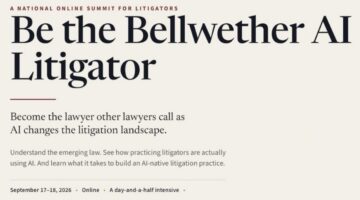
AI Is Coming To Litigation. Get Up To Speed With Bellwether AI Litigator Early Bird Special.
When it comes to AI, what does a litigator need to know — and know how to do — right now?
When it comes to AI, what does a litigator need to know — and know how to do — right now?

Courts are beginning to impose 'enterprise-grade' AI requirements that may do little more than price solos and small firms out of using the technology.

New executive research from Ari Kaplan explores how law firm leaders are responding to changing client expectations, evolving economics, talent transformation, and AI governance.

A self-scheduled, prepaid consultation fee is exactly the kind of low-stakes, high-access tool solos and smalls should be able to use without a compliance department.

Regulators aren’t providing guidance quickly enough, and while large firms have access to in-house ethics advisors, solos and smalls don’t.

Now with guidance from NYC Opinion 1270 on ethical issues related to attorneys using AI transcription, and more.

The legal profession needs to understand what benchmarks are, how they work, and whether existing ethics rules are equipped to handle them.

Grounded in authoritative content and verified at every step, Protégé is the only legal AI tool that delivers work you can trust—without exception.

Despite their different approaches, Foonberg and Fan have more in common than you’d expect.

If AI reduces the cost of producing legal work, the real question is not whether lawyers will generate more of it, but instead, whether they should.

For lawyers and their clients, the risks of hiring an unqualified coach are substantial.

The claim that general-purpose AI platforms are categorically unsuitable for attorney use with client matters is wrong, not as a matter of opinion but as a matter of doctrine.
AI can accelerate document review, but metrics alone aren't enough. Learn how Managing Attorney oversight turns AI-driven review into a more adaptive, strategic and defensible process.

If you missed it live, this is a chance to see how AI can support your real legal work in a practical, usable way.

An examination of how MSOs operate, how they differ from other outsourcing arrangements, what the ethics rules say, and why solos and small firms may be better served by the alternatives that are already available to them.

These are supposed to be the heavyweights of the legal profession, and they couldn’t muster the courage to put their names on a public court filing.

Meaningful work doesn’t always happen at a desk. Let AI improve your work-life balance.
Why can’t we just say that an expectation of privacy applies to generative AI and speak a privilege into existence?